(Default behavior)
(This is what we want)
Default Class Behavior
We've been assigning StopWatch objects and initializing them without any regards to how this is done:The compiler made it for us.// Construction (conversion constructor) StopWatch sw1(60); // 00:01:00 // Initialization StopWatch sw2 = sw1; // 00:01:00 // Construction (default constructor) StopWatch sw3; // 00:00:00 // Assignment: sw3.operator=(sw1); // Where did this operator come from? sw3 = sw1; // 00:01:00
struct Foo
{
  int a, b, c;
};

Foo f1 = {1, 2, 3}; // initialization
Foo f2 = f1;        // initialization
Foo f3;             // uninitialized
f3 = f1;            // assignment
Foo& Foo::operator=(const Foo& rhs)
{
  a = rhs.a; // assignment!
  b = rhs.b; // assignment!
  c = rhs.c; // assignment!

  return *this; // Allows chaining: f1 = f2 = f3 etc...
}
  // Infix notation
f3 = f1;

  // Functional notation
f3.operator=(f1);
In addition to the default copy assignment operator, the compiler will also provide a default copy constructor. (Once again, another function will be called to help the compiler perform its job.)
Foo::Foo(const Foo& rhs) : a(rhs.a), b(rhs.b), c(rhs.c) // initialization!
{
}
Foo f1;     // default constructor
Foo f2(f1); // copy constructor
| Pass by value | Return by value |
|---|---|
|
|
| Default constructor (does nothing) | Default destructor (does nothing) |
|---|---|
|
|
| Default copy assignment operator (memberwise assignment) | Default copy constructor (memberwise initialization) |
|
|
| Class definition | Some implementations |
|---|---|
|
|
void f6()
{
  Student john("john", 20, 3, 3.10f);
  Student billy("billy", 21, 2, 3.05f);

  billy = john; // Assignment
}
Student constructor for john
Student constructor for billy
Student destructor for john
Student destructor for ,oļa,oļa?
  22292 [sig] a 2032 open_stackdumpfile: Dumping stack trace to a.exe.stackdump
  22292 [sig] a 2032 open_stackdumpfile: Dumping stack trace to a.exe.stackdump
 742008 [sig] a 2032 E:\Data\Courses\Notes\CS170\Code\Classes3\a.exe: *** fatal error -
        E:\Data\Courses\Notes\CS170\Code\Classes3\a.exe: *** called with threadlist_ix -1
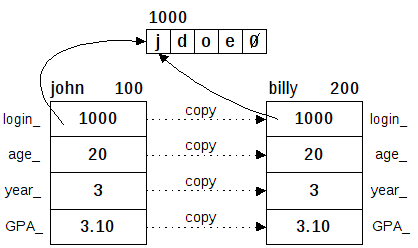
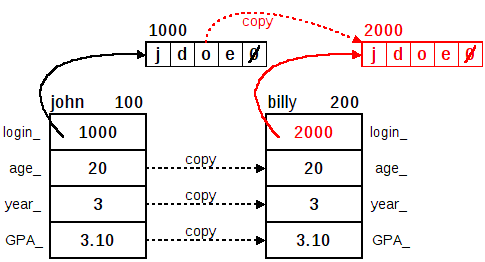
Here's a graphic of the problem:
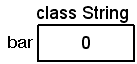
| Incorrect assignment behavior (shallow copy) (Default behavior) | Correct assignment behavior (deep copy) (This is what we want) |
|---|---|
|
|
|
The diagram shows the painful truth: The default copy assignment operator won't cut it. Also, the default copy constructor will have the same problem, so this code will also fail:
Student john("john", 20, 3, 3.10f);

  // Copy constructor
Student billy(john);
A Proper Assignment Operator and Copy Constructor
Adding a copy assignment operator is no different than any other operator:
| Declaration | Implementation |
|---|---|
|
|
| Default copy assignment operator | Our correct and safe copy of login_ |
|---|---|
|
|
There is more work to be done. Many (if not all) new C++ programmers fall into this trap a lot:
| Sample code | Output |
|---|---|
|
Student constructor for jdoe Error in age range! Error in year range! Student constructor for Student operator= for ,oļa,oļa? Student destructor for Student destructor for ,oļa,oļa? |
For example, this is perfectly legal (if not strange):
int i = 5;
i = i; // Should this invalidate your program?
Student& Student::operator=(const Student& rhs)
{
    // Check for self-assignment
  if (&rhs != this)
  {
    set_login(rhs.login_);
    set_age(rhs.age_);
    set_year(rhs.year_);
    set_GPA(rhs.GPA_);
  }

  return *this;
}
A similar problem exists with the default copy constructor:
| Client code | Default copy constructor (not good) |
|---|---|
|
|
| Declaration | Implementation (almost correct) |
|---|---|
|
|
Points:
| Private helper function | Calling the helper function |
|---|---|
|
|
Student st(st); // Self-copy? Legal, but makes no sense. Kind of like: int i = i;
void Student::set_login(const char* login)
{
    // Delete "old" login (THIS IS A POTENTIAL PROBLEM)
  delete [] login_;

    // Allocate new one
  int len = (int)std::strlen(login);
  login_ = new char[len + 1];
  std::strcpy(login_, login);
}
void Student::copy_data(const Student& rhs)
{
    // What is the value of our login_ (this->login_) when the constructors call this method?
  set_login(rhs.login_);
  set_age(rhs.age_);
  set_year(rhs.year_);
  set_GPA(rhs.GPA_);
}
| Setting login_ in the body | Using the member initializer list |
|---|---|
// Constructor
Student::Student(const char * login,
                 int age, int year,
                 float GPA)
{
  login_ = 0;
  set_login(login);
  set_age(age);
  set_year(year);
  set_GPA(GPA);
}

// Explicit copy constructor
Student::Student(const Student& student)
{
  login_ = 0;
  copy_data(student);
}
|
|
|
As a rule, if you use new in your constructor, you will need to create
This is Item #11 from Scott Meyers' book. The option for GNU (-Weffc++) will warn you about that. |
Creating a String Class
#include <iostream> // ostream

class String
{
  public:
    String();                 // default constructor (empty string)
    String(const char *cstr); // conversion constructor (C-style to String)
    ~String();                // destructor (clean up)

      // So we can use cout
    friend std::ostream & operator<<(std::ostream &os, const String &str);

  private:
    char *string_; // the "real" string (A NUL terminated array of characters)
};
Once these methods are implemented, this trivial program will work:
void f1()
{
  String s("Hello");
  std::cout << s << std::endl;
}
Implementations so far:Conversion constructor: Hello Hello Destructor: Hello
|
|
|
|
|
|
|
Output: 1. Conversion constructor: Euclid 2. *** Start of main... 3. Conversion constructor: Newton 4. Newton 5. *** Start of Create1... 6. Conversion constructor: Plato 7. Plato 8. *** End of Create1... 9. Destructor: Plato 10. *** Start of Create2... 11. Conversion constructor: Pascal 12. Pascal 13. *** End of Create2... 14. 0x653290 15. Pascal 16. Euclid 17. Destructor: Pascal 18. *** End of main... 19. Destructor: Newton 20. Destructor: Euclid |
Notice the two different uses of new and delete in the program:1. Conversion constructor: Euclid 2. *** Start of main... 3. Conversion constructor: Newton 4. Newton 5. *** Start of Create1... 6. Conversion constructor: Plato 7. Plato 8. *** End of Create1... 9. Destructor: Plato 10. *** Start of Create2... 11. Conversion constructor: Pascal 12. Pascal 13. *** End of Create2... 14. 0x653290 15. Pascal 16. Euclid 17. Destructor: Pascal 18. *** End of main... 19. Destructor: Newton 20. Destructor: Euclid
At this point, we are missing quite a bit of functionality for a general purpose String class. But first, let's fix the problems. There are problems?
Fixing the String Class
Here's a program that "appears" to work, but then causes a big problem:
void foo()
{
  String one("Pascal");
  String two(one);

  cout << one << endl;
  cout << two << endl;
}
Pascal
Pascal
Destructor: Pascal
Destructor: ,oļa,oļa?
     69 [sig] a 1864 open_stackdumpfile: Dumping stack trace to a.exe.stackdump
     69 [sig] a 1864 open_stackdumpfile: Dumping stack trace to a.exe.stackdump
Here's another similar use of the class:
void PrintString(String s)
{
  cout << s << endl;
}

void f3()
{
  String str("Pascal");
  PrintString(str);
}
Conversion constructor: Pascal
Pascal
Destructor: Pascal
Destructor: ,oļa,oļa?
     63 [sig] a 836 open_stackdumpfile: Dumping stack trace to a.exe.stackdump
     63 [sig] a 836 open_stackdumpfile: Dumping stack trace to a.exe.stackdump
1599112 [sig] a 836 E:\Data\Courses\Notes\CS170\Code\Classes3\a.exe: *** fatal error -
                    E:\Data\Courses\Notes\CS170\Code\Classes3\a.exe: *** called with threadlist_ix -1
What could possibly be causing this? Remember this rule?
To help understand the problem, look at the difference between these functions:
void PrintString(String s); // How expensive is this? What is sizeof(s)?
void PrintString(String &s);
void PrintString(const String &s);
Finally, we have this that "appears" to work until it crashes:
void f5()
{
  String one("Pascal");
  String two;

  two = one;

  cout << one << endl;
  cout << two << endl;
}
Conversion constructor: Pascal
Default constructor
Pascal
Pascal
Destructor: Pascal
Destructor: ,oļa,oļa?
     64 [sig] a 1164 open_stackdumpfile: Dumping stack trace to a.exe.stackdump
     64 [sig] a 1164 open_stackdumpfile: Dumping stack trace to a.exe.stackdump
1508162 [sig] a 1164 E:\Data\Courses\Notes\CS170\Code\Classes3\a.exe: *** fatal error -
                     E:\Data\Courses\Notes\CS170\Code\Classes3\a.exe: *** called with threadlist_ix -1
class String
{
  public:
    String();                  // default constructor
    String(const String& rhs); // copy constructor
    String(const char *cstr);  // conversion constructor
    ~String();                 // destructor

      // Copy assignment operator
    String& operator=(const String& rhs);

      // So we can use cout
    friend std::ostream& operator<<(std::ostream& os, const String &str);

  private:
    char *string_; // the "real" string
};
| Copy constructor | Copy assignment operator |
|---|---|
|
|
Testing:Aside:
1. What if new fails? (It can and does happen.)
2. Why aren't we doing any data validation when copying or assigning the private data?
| Copy test | Output |
|---|---|
|
Conversion constructor: Pascal Copy constructor: Pascal Pascal Pascal Destructor: Pascal Destructor: Pascal |
| Assignment test | Output |
|---|---|
|
Conversion constructor: Pascal Default constructor operator=: = Pascal Pascal Pascal Destructor: Pascal Destructor: Pascal |
Enhancing the String Class
There are many features and functions we could add to the String class to make it more useable.
| Declaration | Implementation |
|---|---|
|
|
| Test | Output |
|---|---|
|
Conversion constructor: Digipen Digipen Length of string: 7 Destructor: Digipen |
A couple more functions:
We need to include this:
#include <cctype> // islower, isupper
| Convert to uppercase | Convert to lowercase |
|---|---|
|
|
| Test | Output |
|---|---|
|
Conversion constructor: Digipen Digipen digipen DIGIPEN Destructor: DIGIPEN |
Policy examples:Policy: Converting a String to uppercase is simple and straight-forward and everyone that has ever programmed in their lives is familiar with a function like this. The resulting String will be exactly what everyone expected, without exception. However, there is this thing called Policy which determines how the String is manipulated and there are generally two schools of thought, neither or which is right/wrong, better/worse. For example, some String libraries will convert the original string to uppercase in-place, overwriting the original lowercase characters. Other libraries will make a copy of the orginal string and convert that copy to uppercase and return it.
How about comparing two Strings?String& upper(String &str); // Modifies String in-place, returns a reference. void upper(String &str); // Modifies the String in-place, returns nothing. String upper(const String &str); // Makes a copy of the String and returns the copy in uppercase.
void f3()
{
  String s1("One");
  String s2("Two");

  if (s1 < s2)
    std::cout << s1 << " is before " << s2 << std::endl;
  else
    std::cout << s1 << " is not before " << s2 << std::endl;

  if (s2 < s1)
    std::cout << s2 << " is before " << s1 << std::endl;
  else
    std::cout << s2 << " is not before " << s1 << std::endl;

  if (s1 < s1)
    std::cout << s1 << " is before " << s1 << std::endl;
  else
    std::cout << s1 << " is not before " << s1 << std::endl;
}
Declaration in the String class:Conversion constructor: One Conversion constructor: Two One is before Two Two is not before One One is not before One Destructor: Two Destructor: One
Implementation:bool operator<(const String& rhs) const;
bool String::operator<(const String& rhs) const
{
    // if we're 'less' than rhs
  if (std::strcmp(string_, rhs.string_) < 0)
    return true;
  else
    return false;
}
What about this?bool operator>(const String& rhs) const; bool operator==(const String& rhs) const; bool operator<=(const String& rhs) const; bool operator>=(const String& rhs) const; bool operator!=(const String& rhs) const; bool operator==(const String& rhs) const;
String s1("Digipen");

if (s1 < "Hello")
  std::cout << "Hello is less" << std::endl;
else
  std::cout << "Hello is NOT less" << std::endl;
Conversion constructor: Digipen
Conversion constructor: Hello
Destructor: Hello
Destructor: Digipen
String s1("Digipen");

if ("Hello" < s1)
  std::cout << "Hello is less" << std::endl;
else
  std::cout << "Hello is NOT less" << std::endl;
In function 'void f4()':
error: no match for 'operator<' (operand types are 'const char [6]' and 'String')
   if ("Hello" < s1)
               ^
if (String("Hello") < s1)
|
Conversion constructor: Digipen Conversion constructor: Hello Destructor: Hello Hello is NOT less Destructor: Digipen |
Now the user can compare Strings with NUL-terminated strings as easily as comparing two Strings. This is the whole point of overloading operators: Give the users the ability to work with user-defined types as naturally as they work with built-in types (e.g. integers).
Going one step further
It would be nice if we could directly compare a String with a NUL-terminated string without having to construct a temporary String first. We can do that if we can access the underlying NUL-terminated string. (Remember, the String class is just a wrapper around a C-style NUL-terminated string.)
// declare in public section of .h file const char *c_str() const; |
|
bool operator<(const char *lhs, const String& rhs)
{
  return std::strcmp(lhs, rhs.c_str()) < 0;
}
String s1("Digipen");

if ("Hello" < s1)
  std::cout << "Hello is less" << std::endl;
else
  std::cout << "Hello is NOT less" << std::endl;
| New output | Old output |
|---|---|
Conversion constructor: Digipen Hello is NOT less Destructor: Digipen |
Conversion constructor: Digipen Conversion constructor: Hello Destructor: Hello Hello is NOT less Destructor: Digipen |
// optimization
bool String::operator<(const char *rhs) const
{
    // if we're 'less' than rhs
  if (std::strcmp(string_, rhs) < 0)
    return true;
  else
    return false;
}
bool operator<(const char *lhs, const String& rhs) // global, e.g. "Hello" < s1
bool String::operator<(const String& rhs) const    // member, e.g. s1 < s2
bool String::operator<(const char *rhs) const      // member, e.g. s1 < "Hello"
More Enhancements to the String Class
There is an obvious feature that is missing from the String class: subscripting. We should be able to do this:
String s1("Digipen");

  // c should have the value 'g'
char c = s1[2];
| Declaration | Implementation |
|---|---|
|
|
| Sample usage | Output |
|---|---|
|
D i g i p e n |
char String::operator[](int index) const
{
    // Validate the index
  if ( (index >= 0) && (index < size()) )
    return string_[index];
  else
    return string_[0]; // What to return??? This is a BIG problem
                       //   that we'll postpone for now. (EH)
}
| Compiler error: | |
|---|---|
|
error: non-lvalue in assignment <----- can't assign to a temporary value |
| Return a reference | Compiles and runs |
|---|---|
|
Output: Cello |
| Try a const object | Compiles and runs fine |
|---|---|
|
D i g i p e n |
| Modify const object | No problemo |
|---|---|
|
Output: Cello |
| Return a const reference | Compiler error as expected |
|---|---|
|
|
void f4()
{
  String s1("Hello");

    // Compiler error: assignment of read-only location
  s1[0] = 'C';

  std::cout << s1 << std::endl;
}
void f7()
{
  String s1("Hello");         // non-const object
  const String s2("Goodbye"); // const object

    // non-const: This should be allowed
  s1[0] = 'C';

    // const: This should produce an error
  s2[0] = 'F';
}
const char& operator[](int index) const; // for r-values
      char& operator[](int index) const; // for l-values
|
|
They are both const methods, since neither one is modifying the private fields.
One returns a const reference and the other returns a non-const reference.
The proper way:
const char& operator[](int index) const; // for r-values
      char& operator[](int index);       // for l-values
Example code now works as expected:The const at the end is part of the method's signature and the compiler uses it to distinguish between the two methods.
void f8()
{
  String s1("Hello");         // non-const object
  const String s2("Goodbye"); // const object

    // Calls non-const version, l-value assignment (write) is OK
  s1[0] = 'C';

    // Calls const version, l-value assignment (write) is an error
  //s2[0] = 'F';

    // Calls non-const version, r-value read is OK
  char c1 = s1[0];

    // Calls const version, r-value read is OK
  char c2 = s2[0];
}
Class Methods and static Members
Suppose we add a public data member to the String class:
class String
{
  public:
    // Other public members...

    int foo; // public data member

  private:
    char *string_; // the "real" string
};
| Test code | Output |
|---|---|
|
Conversion constructor: foo Conversion constructor: bar Conversion constructor: baz 10 20 30 Destructor: baz Destructor: bar Destructor: foo |
|
Conversion constructor: foo Conversion constructor: bar Conversion constructor: baz 1627408208 4268368 4268368 Destructor: baz Destructor: bar Destructor: foo |
So this code:
String s1("foo");
String s2("bar");
String s3("baz");
s1.foo = 10;
s2.foo = 20;
s3.foo = 30;
We must always initialize any non-static data in the class, otherwise it's undefined. Non-static? As opposed to what? Static?
By default, members of a class are non-static. If you want them to be static, you must indicate it with the static keyword.
Adding a static member is trivial:Unfortunately, the meaning of static is completely different from the other meanings we've learned.
class String
{
  public:
    // Other public members...

    int foo;        // non-static
    static int bar; // static

  private:
    char *string_; // the "real" string
};
  // Accessing a static member with the scope resolution operator
int i = String::bar;
std::cout << i << std::endl;
| Header file (.h) | Implementation file (.cpp) |
|---|---|
|
|
Note that you must do it this way:/cygdrive/h/temp/ccZm55jF.o:main.cpp:(.text+0xf8d): undefined reference to 'String::bar' collect2: ld returned 1 exit status
Just doing this:int String::bar = 0; // Need the leading int keyword (It's a definition)
is simply assigning a new value to String::bar.String::bar = 0; // Assignment
Each object has a separate storage area for foo, but bar is shared between them:
Note: Static data members are NOT counted with the sizeof operator. Only non-static data is included. This is true when using sizeof with either the class itself, or objects of the class.
Methods can be static as well:
| Declarations | Definitions |
|---|---|
|
|
void f8()
{
    // Accessing a static member
  int i = String::get_bar();

    // Error, private now
  i = String::bar;
}
void f9()
{
  String s1("foo");

  int x = s1.get_bar();      // Access through object
  int y = String::get_bar(); // Access through class
}
class String
{
  public:
    // Other public members...

      // can be initialized in the class
    const static int foo = 47;

  private:
    // Other private members...

      // can be initialized in the class
    const static char bar = 'B';
};
Example
Suppose we want to keep track of how many String objects were created, how many total bytes were allocated, and how many Strings are currently active? This is a good candidate for static members.This is what the updated String class looks like:
In String.h:
class String
{
  public:
    String();                  // default constructor
    String(const String& rhs); // copy constructor
    String(const char *cstr);  // conversion constructor
    ~String();                 // destructor

      // Copy assignment operator
    String& operator=(const String& rhs);

    static int created_;    // Total number of Strings constructed
    static int alive_;      // Total number of Strings still around
    static int bytes_used_; // Total bytes allocated for all Strings

    // Other public members

  private:
    char *string_;  // the "real" string

    // Other private members
};
Updated member functions:// Define and initialize the static members int String::bytes_used_ = 0; int String::created_ = 0; int String::alive_ = 0;
Sample test program:
Default constructor Conversion Constructor String::String() { // Allocate minimal space string_ = new char[1]; string_[0] = 0; bytes_used_ += 1; created_++; alive_++; #ifdef PRINT std::cout << "Default constructor" << std::endl; #endif }String::String(const char *cstr) { // Allocate space and copy int len = (int)strlen(cstr); string_ = new char[len + 1]; std::strcpy(string_, cstr); bytes_used_ += len + 1; created_++; alive_++; #ifdef PRINT std::cout << "Conversion constructor: " << cstr << std::endl; #endif }Destructor Copy Constructor String::~String() { #ifdef PRINT std::cout << "Destructor: " << string_ << std::endl; #endif delete [] string_; // release the memory alive_--; }String::String(const String& rhs) { int len = (int)strlen(rhs.string_); string_ = new char[len + 1]; std::strcpy(string_, rhs.string_); bytes_used_ += len + 1; created_++; alive_++; #ifdef PRINT std::cout << "Copy constructor: " << rhs.string_ << std::endl; #endif }
Copy assignment operator String& String::operator=(const String& rhs) { #ifdef PRINT std::cout << "operator=: " << string_ << " = " << rhs.string_ << std::endl; #endif if (&rhs != this) { delete [] string_; int len = (int)strlen(rhs.string_); string_ = new char[len + 1]; std::strcpy(string_, rhs.string_); bytes_used_ += len + 1; } return *this; }
#include <iostream> // cout, endl
#include "String.h" // String class

// Print static data
void print_stats()
{
  std::cout << "Strings created: " << String::created_ << ", ";
  std::cout << "Bytes used: " << String::bytes_used_ << ", ";
  std::cout << "Strings alive: " << String::alive_ << std::endl;
}

// Pass a copy, return a copy
String pass_by_val(String s)
{
  return s; // return a copy
}

// Pass a reference, return a reference
const String& pass_by_ref(const String& s)
{
  return s; // return a reference
}

void f1()
{
  String s1("Hello");
  print_stats(); // Strings created: 1, Bytes used: 6, Strings alive: 1

  String s2(s1);
  print_stats(); // Strings created: 2, Bytes used: 12, Strings alive: 2

  pass_by_val(s1);
  print_stats(); // Strings created: 4, Bytes used: 24, Strings alive: 2

  pass_by_ref(s1);
  print_stats(); // Strings created: 4, Bytes used: 24, Strings alive: 2

  s1 = "Goodbye";
  print_stats(); // Strings created: 5, Bytes used: 40, Strings alive: 2

  s2 = s1;
  print_stats(); // Strings created: 5, Bytes used: 48, Strings alive: 2

  String s3;
  print_stats(); // Strings created: 6, Bytes used: 49, Strings alive: 3
}

int main()
{
  print_stats(); // Strings created: 0, Bytes used: 0, Strings alive: 0
  f1();
  print_stats(); // Strings created: 6, Bytes used: 49, Strings alive: 0
}
Output: (with PRINT defined)1. Strings created: 0, Bytes used: 0, Strings alive: 0 2. Strings created: 1, Bytes used: 6, Strings alive: 1 3. Strings created: 2, Bytes used: 12, Strings alive: 2 4. Strings created: 4, Bytes used: 24, Strings alive: 2 5. Strings created: 4, Bytes used: 24, Strings alive: 2 6. Strings created: 5, Bytes used: 40, Strings alive: 2 7. Strings created: 5, Bytes used: 48, Strings alive: 2 8. Strings created: 6, Bytes used: 49, Strings alive: 3 9. Strings created: 6, Bytes used: 49, Strings alive: 0
1. Strings created: 0, Bytes used: 0, Strings alive: 0

   Conversion constructor: Hello
2. Strings created: 1, Bytes used: 6, Strings alive: 1

   Copy constructor: Hello
3. Strings created: 2, Bytes used: 12, Strings alive: 2

   Copy constructor: Hello
   Copy constructor: Hello
   Destructor: Hello
   Destructor: Hello
4. Strings created: 4, Bytes used: 24, Strings alive: 2

5. Strings created: 4, Bytes used: 24, Strings alive: 2

   Conversion constructor: Goodbye
   operator=: Hello = Goodbye
   Destructor: Goodbye
6. Strings created: 5, Bytes used: 40, Strings alive: 2

   operator=: Hello = Goodbye
7. Strings created: 5, Bytes used: 48, Strings alive: 2

   Default constructor
8. Strings created: 6, Bytes used: 49, Strings alive: 3

   Destructor:
   Destructor: Goodbye
   Destructor: Goodbye
9. Strings created: 6, Bytes used: 49, Strings alive: 0
Self-check: Given what we've been discussing for the past week, how would you get rid of the extra (read: unnecessary) construction in #6 above? (Hint: Add another function)