Results
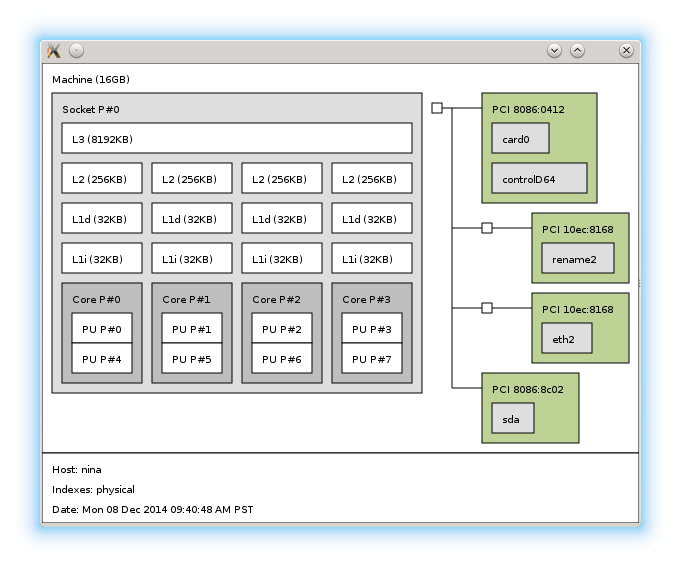
The data set is 1,000,000 integers using g++ version 8.1 and optimization level -O2.The computer used for the testing is nina:
Operating System      Linux Mint 17 Qiana 3.13.0-24-generic x86_64
Model                 Shuttle Inc. DS81D
Model ID
Motherboard           Shuttle Inc. FS81
Processor             Intel(R) Core(TM) i7-4790S CPU @ 3.20GHz
                      1 Processor, 4 Cores, 8 Threads
Processor ID          GenuineIntel Family 6 Model 60 Stepping 3
L1 Instruction Cache  32.0 KB x 4
L1 Data Cache         32.0 KB x 4
L2 Cache              256 KB x 4
L3 Cache              8.00 MB
Memory                15.6 GB
BIOS                  American Megatrends Inc. 3.08
System topology:
Table of results (with compiler optimization level -O2)
Data structure insert*
(random)delete*
(random)insert
(sorted)delete
(sorted)insert
(sorted rev.)delete
(sorted rev.)find*
(random)AVL tree 0.689 0.842 0.186 0.197 0.185 0.196 0.345 Red-black tree 0.653 0.601 0.223 0.110 0.228 0.109 0.328 Skiplist 0.790 0.768 0.138 0.066 0.111 0.111 0.054 BList1 1.837 2.461 6.297 (no opt)2
0.691 (w/opt)30.175 0.475 3.371 2.402 Hash table (OA)4 0.213 0.655 (PACK)5
0.187 (MARK)60.222 Hash table (chaining)7 0.360 0.345 0.346
* These columns are the most relevant because they represent the average/typical case.
1The BList was tested with 2,048 items per node.
2No special optimizations were made and the normal search code was used to find the position.
3Before walking the list looking for the insertion point, a check was made to see if the value being inserted was larger than the largest element in the list. This meant no searching was required and it could simply be inserted at the end.
4The confguration: load factor is 0.667, hash function is Super Fast, and the collision resolution policy is linear probing.
5When an item is deleted, the remaining items in the cluster are reinserted into the table.
6When an item is deleted, the slot is simply marked as DELETED.
7The confguration: load factor is 5, hash function is Super Fast.
Here are some blist benchmarks that show the differences in performance.
It's important to realize that the times are only for the operations listed. Constructors and destructors were not part of the timings, nor was the creation of the sample data. Here's an example of code that is being timed:
// All constructors are called and test data was created ...

  StartTimer();
  for (int i = 0; i < size; i++)
    tree.insert(ia[i]);
  StopTimer();

// All destructors are called and test data was destroyed ...
#include <chrono>

std::chrono::time_point<std::chrono::system_clock> Start;
std::chrono::time_point<std::chrono::system_clock> Stop;

void StartTimer()
{
  Start = std::chrono::system_clock::now();
}

void StopTimer()
{
  Stop = std::chrono::system_clock::now();
}

void PrintElapsedTime()
{
  std::chrono::duration<double> elapsed = Stop - Start;
  std::cout << "Elapsed time: " << std::setprecision(3) << std::fixed
                                << elapsed.count() << std::endl;
}
Things that could affect the performance:
The table above shows that compiler optimization can sometimes have a significant affect on performance. Showing both tables together..
Data structure insert
(random)delete
(random)insert
(sorted)delete
(sorted)insert
(sorted rev.)delete
(sorted rev.)find
(random)AVL tree 1.420 2.015 0.917 1.002 0.902 0.994 0.712 Red-black tree 0.750 0.832 0.354 0.207 0.347 0.197 0.717 Skiplist 1.104 1.177 0.319 0.183 0.245 0.282 0.135 BList (2048) 4.335 3.299 9.377 (no opt)
3.398 (w/opt)1.172 2.914 3.490 2.452 Hash table (OA) 0.269 2.914 (PACK)
1.014 (MARK)0.251 Hash table (chaining) 0.391 0.392 0.367
All of the sizes assume 4-byte integers and 8-byte pointers.
A BST/AVL tree node (size is 32):
template <typename T>
struct BinTreeNode
{
  BinTreeNode *left;  // Left child
  BinTreeNode *right; // Right child
  int balance_factor; // For efficient balancing
  unsigned count;     // Nodes in this subtree (for efficient indexing)
  T data;             // The data
};
template <typename T>
struct RBNode
{
  RBNode *left;   // Left child
  RBNode *right;  // Right child
  RBNode *parent; // Parent node ptr
  RBCOLOR color;  // Color (red or black)
  T data;         // The data
};
| Skiplist | Statistics |
|---|---|
A Skiplist node (size varies from (24 to 140):
|
Number of items: 1000000
Statistics for 1000000 nodes with interval 2:

                  Actual    Ideal
Level  0 nodes:   509596   500000
Level  1 nodes:   249837   250000
Level  2 nodes:   122918   125000
Level  3 nodes:    59911    62500
Level  4 nodes:    29604    31250
Level  5 nodes:    14175    15625
Level  6 nodes:     7124   7812.5
Level  7 nodes:     3475  3906.25
Level  8 nodes:     1767  1953.12
Level  9 nodes:      807  976.562
Level 10 nodes:      388  488.281
Level 11 nodes:      184  244.141
Level 12 nodes:       99   122.07
Level 13 nodes:       49  61.0352
Level 14 nodes:       31  30.5176
Level 15 nodes:       16  15.2588
Level 16 nodes:        7  7.62939
Level 17 nodes:        8   3.8147
Level 18 nodes:        1  1.90735
Level 19 nodes:        2 0.953674
Level 20 nodes:        1 0.476837

   Total nodes: 1000000
Total pointers: 1961892
pointers/nodes: 1.9619
|
| BList | Statistics |
|---|---|
A BList node (size varies from 24 with no limit):
|
Number of items: 1000000 Asize: 2048 Items: 1000000 Nodes: 689 Average items per node: 1451.38 Node utilization: 70.9% (with 2048 integers per node: sizeof(BNode) is 8212 bytes) |
| Open-address hash table | Statistics |
|---|---|
An open-addressed hash table slot (size varies, with MAX_KEYLEN=12, size is 24):
|
Number of items: 1000000 Creating table: Primary hash function: SF Hash Secondary hash function: None (Linear probing) Max load factor: 0.667 Growth factor: 2 Deletion policy: PACK Initial table size: 1500007 Inserting 1000000 items... Number of probes: 6573876 Average probes: 6.57388 Number of expansions: 0 Items: 1000000, TableSize: 1500007 Load factor: 0.667 |
| Closed-address hash table | Statistics |
|---|---|
A closed-addressed (chaining) hash table node (size varies, with MAX_KEYLEN=12, size is 24):
|
Number of items: 1000000 Creating table: Hash function: SF Hash Initial size: 200000 Max load factor: 5 Growth factor: 2 Inserting 1000000 items... Number of probes: 5011635 Average probes: 5.01164 Number of expansions: 0 Items: 1000000, TableSize: 200003 Load factor: 5 |